

Tibialis Posterior: The Overlooked Muscle That Might Be Causing Your Knee and Hip Pain
When most people think about knee or hip pain, they focus on the joints themselves. But one of the most overlooked contributors to lower-extremity pain lies much farther down the chain—deep inside your lower leg.
Meet the tibialis posterior, a small but powerful muscle that plays a major role in foot stability, arch control, and the alignment of your entire leg. If this muscle isn’t working properly, it can create a ripple effect of dysfunction all the way up to your knees and hips.
In this post, we’ll break down what the tibialis posterior is, why it matters, and how dysfunction in this muscle can contribute to knee pain, hip pain, and even chronic tendinopathies.
What Is the Tibialis Posterior?
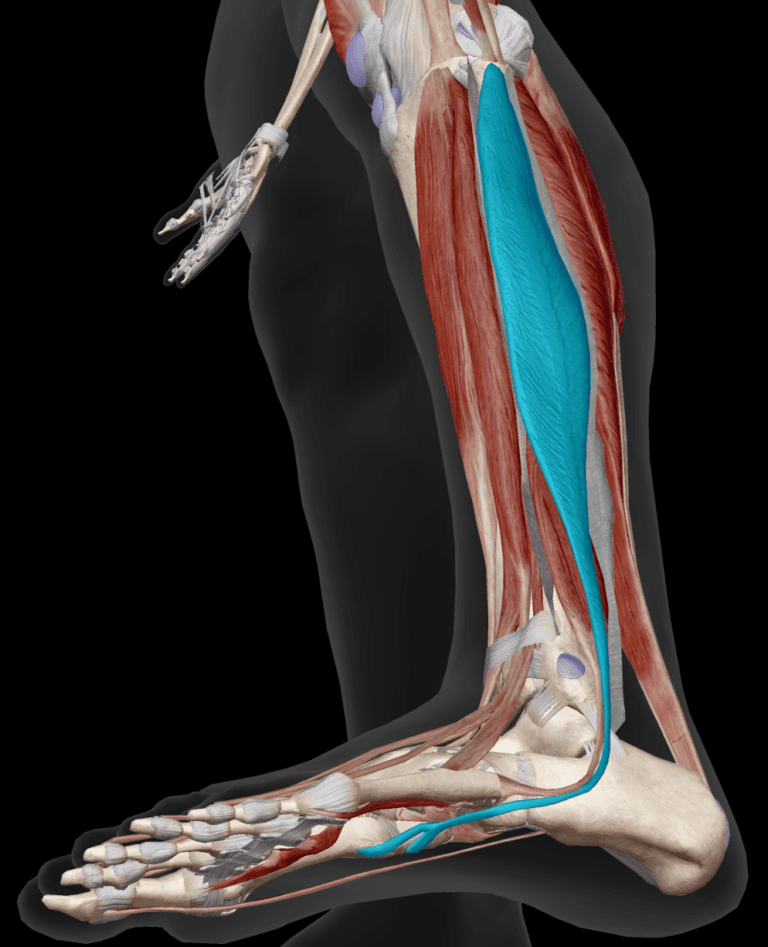
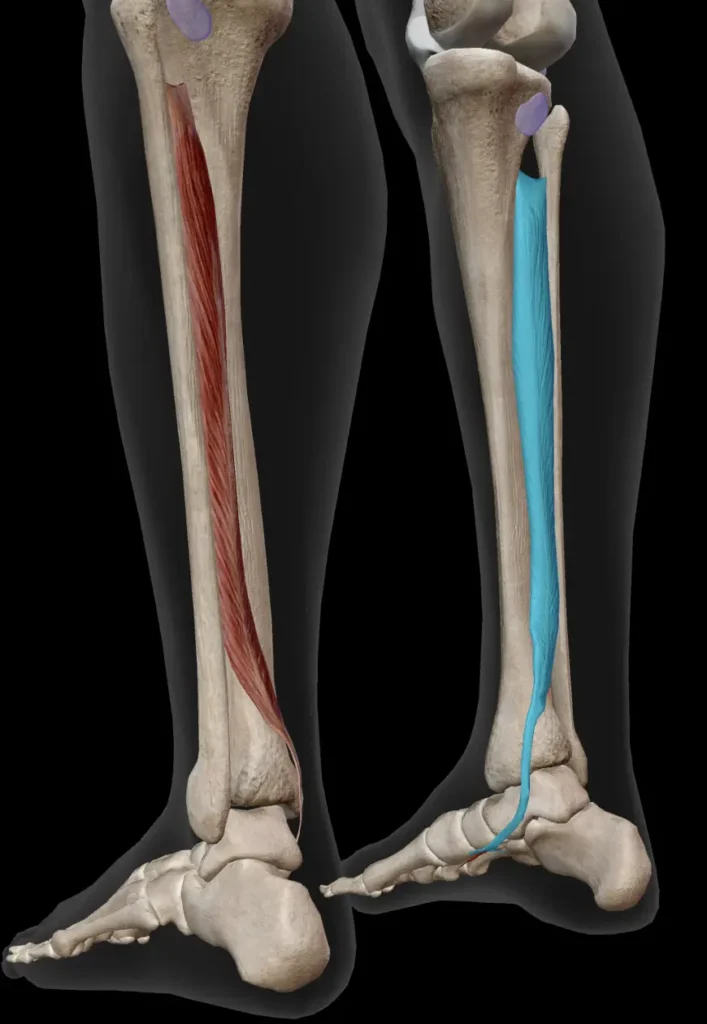
The tibialis posterior is a deep lower-leg muscle located behind the shin. It originates along the posterolateral aspect of the tibia and the medial aspect of the fibula, forming a long muscle belly that narrows into a thin tendon.
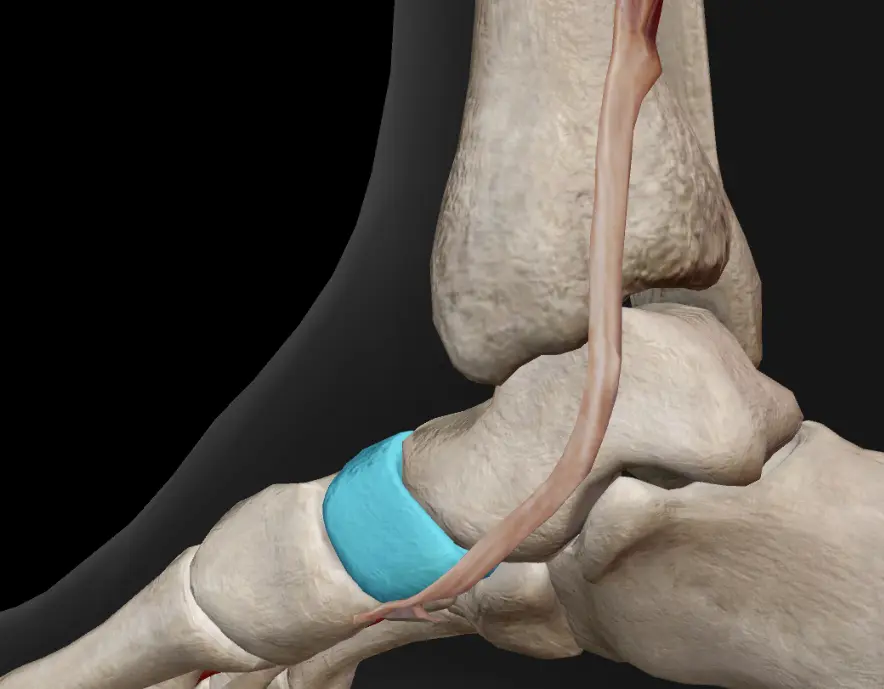
As the tendon travels downward, it wraps behind the inner ankle (medial malleolus) and attaches primarily to the navicular bone of the foot.
The Navicular: The Keystone of Your Arch
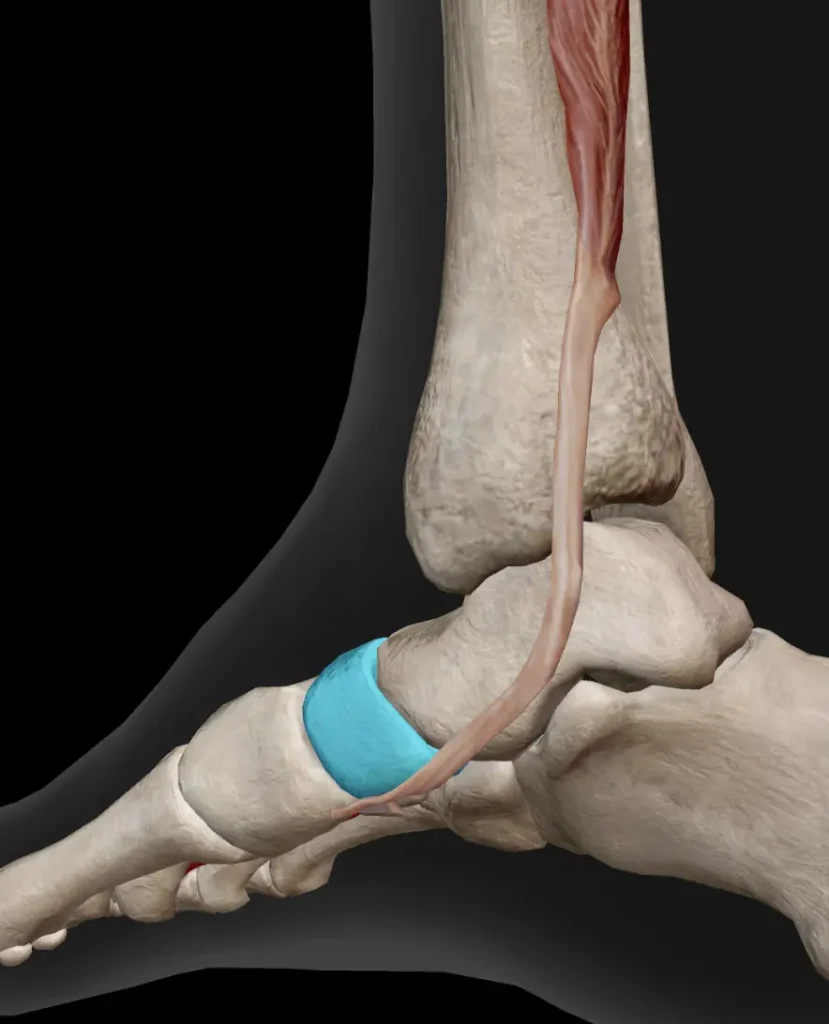
The navicular bone sits on the inside of your midfoot and acts like the keystone of a stone arch. Just as a keystone supports the stones around it, the navicular helps maintain the structural integrity of your foot’s arch.
The tibialis posterior attaches directly to this bone, meaning it plays a critical role in lifting and supporting the arch during standing, walking, and running.
Why the Tibialis Posterior Is So Important?
The tibialis posterior is the primary dynamic stabilizer of the medial (inner) arch. When it contracts:
- It supports the arch, preventing collapse.
- It controls pronation, the inward rolling of the foot.
- It helps maintain proper alignment of the tibia, knee, and hip.
Because of these functions, the TP isn’t just a “foot muscle”—it’s a key player in the biomechanics of your entire lower extremity.
When the TP Fails: How Arch Collapse Leads to Knee and Hip Pain
If the tibialis posterior becomes weak, inhibited, or poorly coordinated, it can no longer support the navicular and the arch effectively. This may lead to excessive arch collapse, which sets off a chain reaction of mechanical stress up the leg.
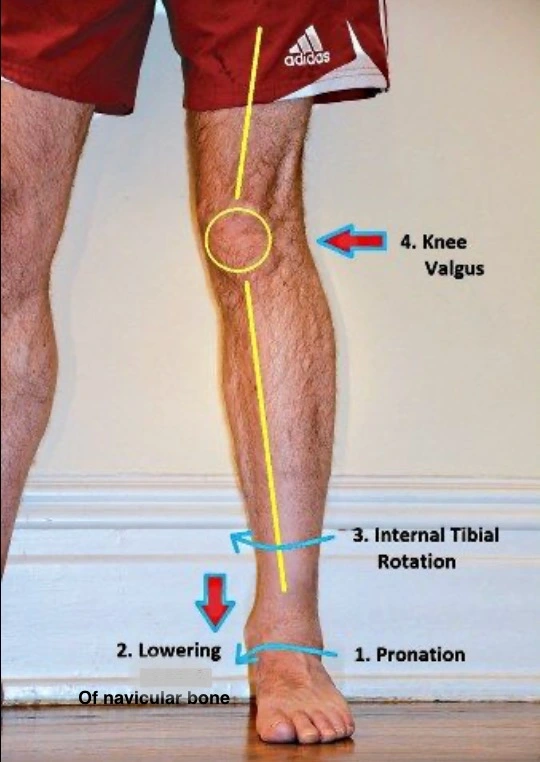
1. Arch Collapse → Excessive Pronation
Without sufficient TP activation, the arch drops and the foot rolls inward too much. This excessive pronation is the first step in a cascade of compensation patterns.
2. Pronation → Tibial Internal Rotation (IR)
As the foot collapses inward, the tibia (shin bone) also rotates internally. This rotation places strain on the knee joint and alters its natural tracking mechanics.
3. Tibial IR → Knee Valgus (“Knock-Knee”)
Internal tibial rotation often leads to knee valgus, where the knee collapses inward. This is a major biomechanical risk factor for:
- Patellofemoral pain
- Lateral knee pain
- ACL strain
- Medial knee instability
4. Knee Valgus → Hip Pain
As the knee collapses inward, the hip must compensate. This can overload structures at the hip, especially near the greater trochanter.
Common issues include:
- Lateral hip pain
- Deep hip aching during walking or running
- Greater trochanteric pain syndrome
- Gluteal tendinopathy
All of this originated from one small but crucial muscle: the tibialis posterior.
Signs Your Tibialis Posterior Might Be Contributing to Your Pain
You might suspect TP dysfunction if you notice:
- Flat or collapsing arches
- Pain along the inside of the ankle
- Difficulty maintaining a neutral foot during squats or single-leg stance
- “Knock-knee” movement patterns during activity
- Lateral knee or hip pain that gets worse with walking or running
If you’ve experienced chronic knee or hip issues that haven’t improved with traditional strengthening or stretching, your tibialis posterior may be the missing puzzle piece.
Final Thoughts: Small Muscle, Big Impact
The tibialis posterior may be a small, hidden muscle, but its impact on your biomechanics is enormous. When it fails to support the arch, the consequences travel all the way up the kinetic chain—often resulting in knee pain, hip pain, instability, and chronic tendinopathies.
Understanding and restoring TP function can be a crucial step toward resolving stubborn lower-extremity pain and improving movement efficiency.
If you’re struggling with knee or hip discomfort and haven’t found the root cause yet, don’t overlook the tibialis posterior—it might be the key to your recovery.
References: Image used
Mechanical knee pain BY SÉAMUS KENNEDY, BENG (MECH), CPED, FAAOP(A) March 22, 2018, https://hersco.com/education-center/knee-pain/